Please click here for any possible tour changes. Learn More Tour Update
close icon

Invasive
Marine Species
in Florida

lionfish

Invasive Species Tour

11:15am | 3:45pm

This tour introduces guests to the serious invasive species problem in Florida through the story of the red lionfish and shares ways that people can help.

From the lionfish to the iguana, the Key West Aquarium has been home to many invasive species in Southern Florida. As part of our commitment to educating our guests about the Florida Keys’ marine life, it is equally important to include a discussion on the impact invasive species have on our delicate Florida ecosystem.

Invasive Species: When Nature’s Balance Is Disrupted

Every ecosystem is connected through a complex network of relationships known as a food web. Within these webs, plants, animals, and microorganisms all play important roles. Producers, consumers, predators, and prey depend on one another to survive, creating a delicate balance that supports healthy ecosystems. 

When these relationships are disrupted, the consequences can ripple throughout the entire environment. One major threat to these natural systems is the introduction of invasive species.

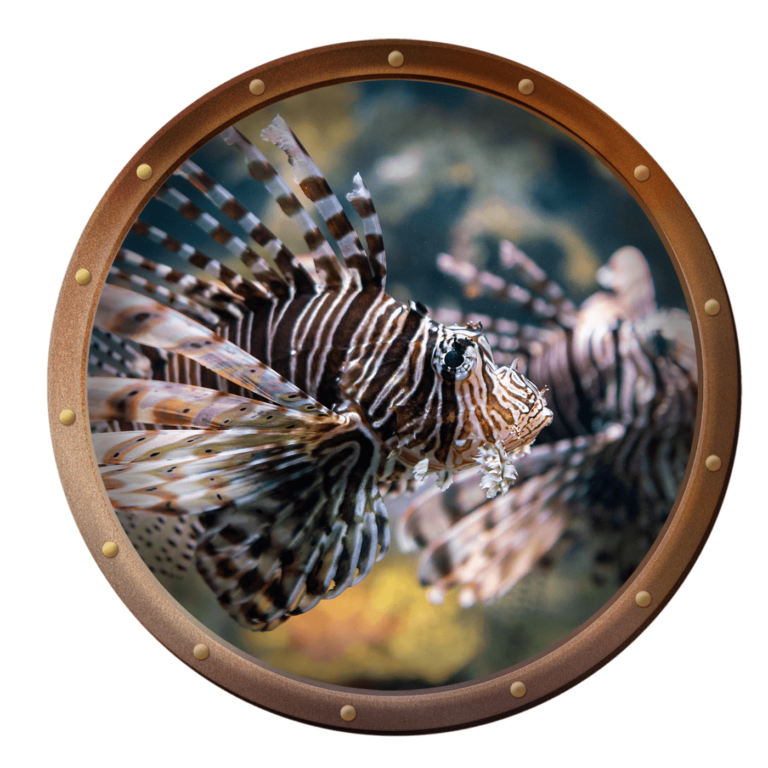
two lionfish

Invasive vs. Non-Native Species 

Species naturally move from one place to another. Seeds can drift on ocean currents, insects can be carried by the wind, and animals may travel on floating debris. These natural movements have occurred throughout Earth’s history. 

However, when humans intentionally or accidentally transport species to places they could never reach on their own, the results can be very different. 


non-native species is a species introduced by humans that is not currently causing harm. In fact, they may even be considered beneficial, such as crops or livestock introduced for food. These species typically: 

  • Do not have an established breeding population, or are under human control 
  • Do not significantly compete with native species for resources 
  • Do not cause ecological or economic damage 
  • Are not a threat to human or animal health 


An invasive species, on the other hand, is non-native to the ecosystem under consideration and whose introduction causes or is likely to cause economic or environmental harm or harm to human health. Invasive species: 

  • Have established breeding populations 
  • Compete with native species for resources such as food and habitat 
  • Reduce native wildlife populations through direct or indirect competition 
  • Cost significant amounts of money to manage and control 
  • May spread disease to human, animal, or plant populations.  


The economic impact of invasive species is enormous. In the United States alone, invasive species cause more than $100 billion in damages and management costs every year. In Florida, management efforts for invasive Burmese pythons alone cost approximately $2 million between 2019 and 2020. 
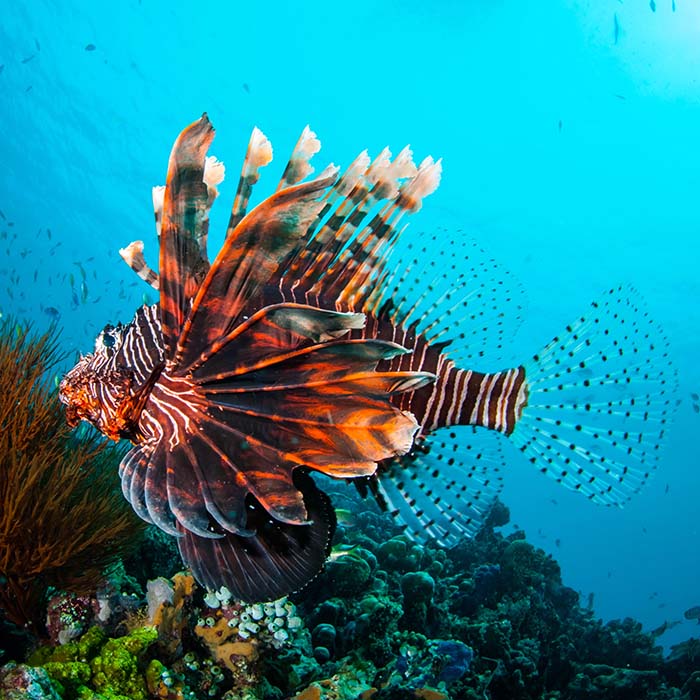
Meet the Lionfish: A Beautiful Invader 

One of the most notorious invasive species found in Florida waters is the red lionfish (Pterois volitans). 

Native to the Red Sea and Indo-Pacific region, lionfish were first introduced into Atlantic waters during the early 1980s. Scientists believe the aquarium trade played a major role in their introduction. 

Some lionfish were likely released intentionally by aquarium owners who no longer wanted to care for them. Others may have escaped during storm events when home aquariums were flooded. Major hurricanes, including Hurricane Andrew, likely helped disperse lionfish and their eggs throughout the region. 

Another possible pathway is through ship ballast water. Large ships take on seawater for stability during ocean crossings and discharge it when they reach port. Lionfish eggs may have been transported in ballast water and released into Atlantic ecosystems. 

Today, lionfish have spread throughout the Caribbean, Gulf of Mexico, and western Atlantic Ocean, from Rhode Island in the north to Rio de Janeiro, Brazil, in the south.

The Perfect Invader

Lionfish have several characteristics that make them particularly successful as an invasive species. Their biology and behavior, coupled with the environmental conditions in the Western Atlantic and Caribbean, created the perfect recipe for an invasion.

Lionfish are remarkably adaptable and can survive in conditions that many other fish cannot. 

They have been found: 

  • In brackish water near river mouths 
  • In highly saline water exceeding 40 parts per thousand 
  • At depths ranging from 1 foot to over 1,000 feet 
  • In water temperatures as low as 50°F 

Their ability to tolerate such a wide range of conditions has helped them colonize vast areas of the Atlantic Ocean.

Lionfish are incredibly effective hunters. 

They feed on small fish and crustaceans, using their large, expandable mouths to engulf prey. A lionfish’s mouth can expand nearly three times its resting size, while its stomach can stretch up to thirty times its normal volume. 

They are capable of swallowing prey that measures up to two-thirds of their own body length. 

Research has shown that lionfish can reduce local prey populations by 80 to 90 percent in less than two months, dramatically altering reef ecosystems. In some areas of the Atlantic, lionfish densities are up to 17 times greater than those found in their native range. 

Lionfish reproduce with astonishing success. 

Females become reproductively mature at only nine months of age and can release 15,000 to 40,000 eggs every three to five days. Over the course of a year, a single female may produce more than 2 million eggs. 

Their eggs are protected by a foul-tasting mucus coating that helps deter predators, increasing the likelihood that young lionfish survive to adulthood. 

In their native Indo-Pacific habitat, lionfish are preyed upon by large groupers, sharks, and eels. 

In the Atlantic, however, lionfish face very little predation. Native predators generally do not recognize lionfish as a food source, while native prey species often fail to recognize them as predators. 

Without these natural controls, lionfish can grow larger than they do in their native range. While lionfish typically reach about 13 inches in the Indo-Pacific, individuals exceeding 20 inches have been documented in Atlantic waters.

Lionfish are famous for their striking appearance. Their bold stripes, dramatic fins, and vibrant colors make them popular aquarium fish. 

These features also serve as an aposematic warning—a signal to potential predators that the animal is dangerous. 

Lionfish possess 18 venomous spines: 

  • 13 dorsal spines 
  • 1 spine on each pelvic fin 
  • 3 anal spines 

These spines deliver a neuromuscular toxin that can cause intense pain. Stings are often described as sharp, burning, throbbing, or crushing and can last for hours or even days. In rare cases, individuals may experience severe allergic reactions. 

The venom is comprised of complex, heat-labile proteins, which means that they can be broken down or neutralized by heat. The recommended first aid treatment is heat. Immersing the affected area in hot water (around 104°F to 113°F, or 40°C to 45°C) for 30 to 90 minutes —or applying a heat pack as hot as can be tolerated without causing burns—helps break down the venom and reduce pain.

Venomous not Poisonous

Fortunately, lionfish are venomous, not poisonous. 

What’s the difference? 

  • Venom is injected by an organism using a mechanical delivery mechanism, such as fangs, stingers, or spines.  
    • If it bites you and you get sick, it’s venomous.  
  • Poison is passively absorbed or ingested. This can be through contact with skin, inhalation, or by swallowing. 
    • If you bite it and you get sick, it’s poisonous.    

The venom is found only in the spines and can be neutralized by heat during cooking.  

In fact, lionfish are considered a delicious seafood option. Their meat is light, mild, and flaky. Studies have shown that lionfish contain fewer heavy metals and higher levels of beneficial omega-3 fatty acids than many popular seafood choices, including tuna and salmon. 

What Can We Do About Invasive Species? 

While invasive species can be challenging to manage, there are many ways individuals can help. 

Prevent New Introductions

Never release aquarium pets or other non-native animals into the wild. 

If you can no longer care for an exotic pet, consider participating in the Florida Fish and Wildlife Conservation Commission’s Exotic Pet Amnesty Program or a similar program in your state. 


Report Invasive Species 

Early detection is one of the most effective tools for preventing invasive species from becoming established. 

In Florida, non-native species sightings can be reported to FWC online or by calling: 

888-Ive-Got1 (483-4681) 


Turn Invasives into a Resource 

People are remarkably good at utilizing resources when there is demand for them. 

One strategy is simple: Eat them to beat them. 

By choosing invasive species such as lionfish at restaurants, seafood markets, and grocery stores, consumers help create incentives for removal efforts. When you go out to eat, ask if lionfish is on the menu. Most places will say no, but asking lets restaurants know there is consumer interest and makes it more likely that they will start serving it.  

Check out this list from Reef Environmental Education Foundation of restaurants that serve lionfish. 

Other products made from invasive species also support management programs, including: 

  • Lionfish jewelry 
  • Leather products made from invasive Burmese pythons 

Become the Predator 

Many invasive species management programs rely on public participation. 

Florida hosts numerous lionfish and python removal events throughout the year. Recreational divers can help remove lionfish directly from local reefs. 

In Florida, lionfish may be harvested year-round with: 

  • No closed season 
  • No bag limit 
  • No minimum size restrictions 
  • No recreational fishing license is required when harvesting lionfish by approved methods 

REEF, Reef Environmental Education Foundation, holds derbies and festivals every year to draw attention to lionfish and promote their removal. For information about lionfish derbies and events, check out the FWC or REEF events pages.

Share What You’ve Learned 

Education is one of the most powerful conservation tools available. 

By sharing information about invasive species, their impacts, and ways to help, you can become part of the solution. Every conversation increases awareness and helps protect native wildlife and the ecosystems we all depend on. 

Together, we can help restore balance to our food webs and preserve healthy oceans for future generations. 

NEWSLETTER

LET´S KEEP IN TOUCH

Receive special offers & latest events.